



Everything you need to know about GMT watches
The term GMT might sound intimidating at first, but it's actually quite simple to understand and represents a very important part of watchmaking history. A watch collector should definitely have a GMT among their timepieces. So here's an article to help you become familiar with this type of model, so dear to the watchmaking world.
This complication is unique in that it displays two or even three different time zones. In addition to showing local time, this special timepiece allows you to read the time in a second time zone thanks to a fourth hand and a chapter ring displaying the 24 hours of a day. Often easily distinguishable from the main hour hand, the second time zone hand features a contrasting color, making it easy to spot at a glance. But let's not reveal too much just yet and return to the history of GMT watches and why they are so popular today.
The origin of the term "GMT"
To better understand this strange nickname, we must go back to the origins of the term GMT. It comes directly from the English language, meaning Greenwich Mean Time. A literal, and somewhat awkward, translation would be: "Greenwich Mean Time." In reality, behind these three rather strange words lies a timekeeping technique: the mean solar time at the Greenwich Meridian. This meridian passes through the Royal Observatory Greenwich, on the outskirts of London in the United Kingdom (we recommend this short detour; you'll discover a magnificent park and a fabulous maritime museum, with the added bonus of a superb panoramic view of the surrounding area).
Today, the Earth is divided into 24 time zones, but it's important to note that this wasn't always the case. For hundreds of years, each part of the globe had its own local time, based on the sun's position. The arrival of railways and various technological advances enabling cross-border travel over much greater distances made these time zones a real puzzle that needed simplifying. It became necessary to introduce uniform time zones across the world. Thus, Greenwich Mean Time served as the global time reference for most of the 20th century, before being replaced by Coordinated Universal Time (UTC) in 1972. Originating in the world of navigation, GMT, by creating an arbitrary boundary (the meridian), divides our planet from east to west to determine geographic longitude.
It's worth noting that our good old GMT is based on the Earth's rotation, while UTC is based on International Atomic Time. Therefore, calculating time is much less precise with a GMT-type measurement technique. But don't worry, today when we talk about GMT complications, it has nothing to do with the accuracy of watches. This term has simply remained in common watchmaking jargon to refer to these very practical timepieces, but horological precision truly comes from the movement! However, be aware that the term GMT is not universally adopted by watchmakers. In fact, it's not uncommon to see brands like SINN (a German company) using the UTC designation instead of GMT.
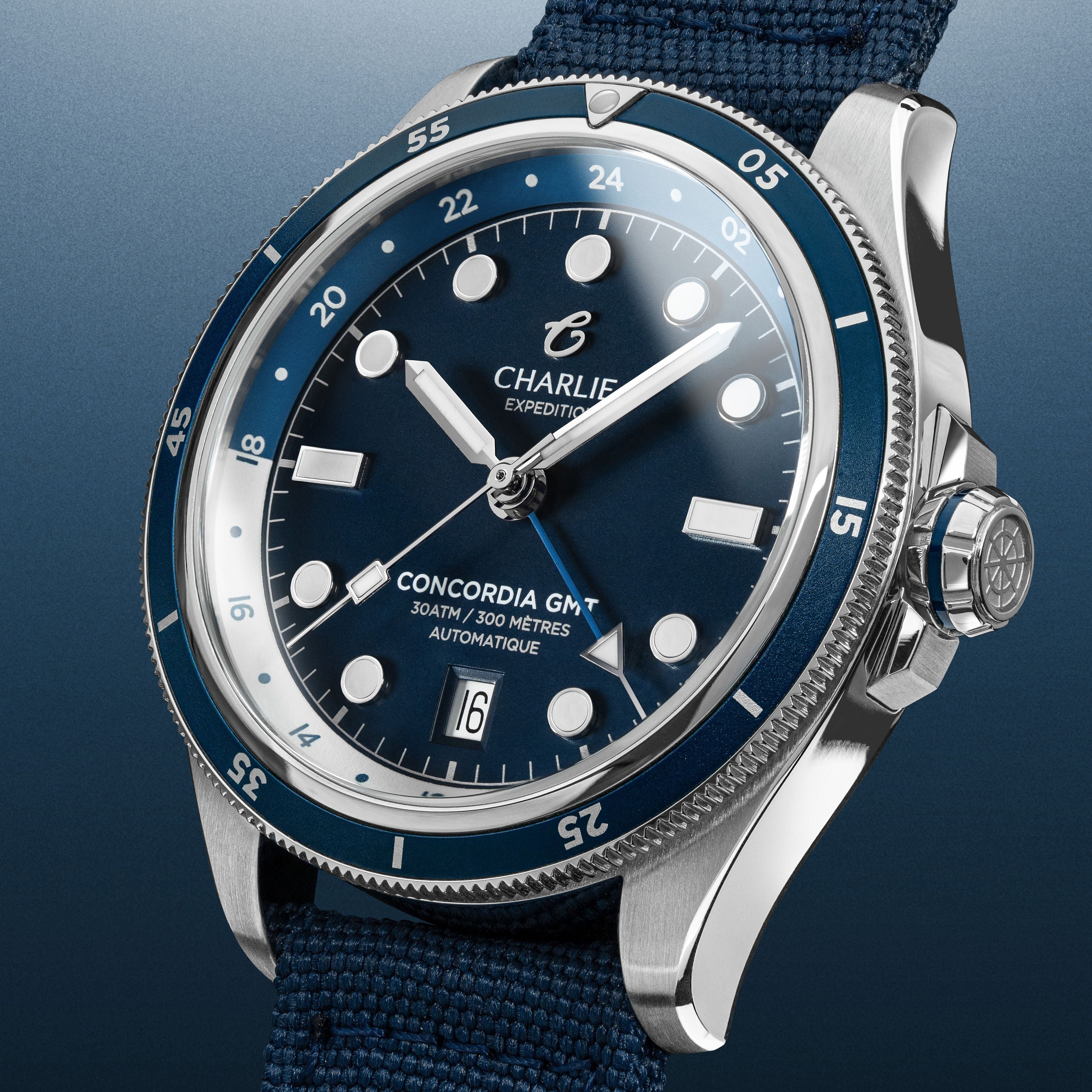
Now that we've gone back in time and better understood the origins of the term GMT, it's necessary to discuss GMT watches and their highly valued complication. The wearer of such a watch can know the exact time in two time zones, as explained in the article's introduction. Reading both time zones is done on the same dial and is made easier by color-coded hands and the chapter ring.The fourth hand functions like that of a 24-hour watch, pointing to the rehaut marked with all the hours of a day. It can be set independently directly via the crown, although it can also be linked to the hour hand.
The GMT watch has thus established itself in the watchmaking world as the preferred accessory for any seasoned globetrotter. Indeed, wherever they are, the experienced traveler with a GMT can know the time in their home country and the time in their host country at a glance. It was precisely for this purpose that the first GMT watch was created in the aftermath of World War II. At that time, international travel was on the rise, and it became essential for pilots to know the exact takeoff and landing times of their flights without cluttering their cockpit view with multiple time indicators. Frequent travelers will increasingly be tempted by this incredibly useful complication for their adventures: knowing the exact time at home to call a family member they miss without waking them, sending a business email without seeming impolite, not being late for a visit or appointment because you forgot to set your watch to the correct time zone… In short, with such a complication, two time zones on your wrist minimize the risk of problems and greatly simplify your life. And besides, isn't it wonderful to have four hands on the same dial?
A GMT watch is often recognized by its famous two-tone bezel, and for good reason! It was created to make it easier to distinguish between morning and afternoon when reading the time in the second time zone. These bezels have lent their nicknames to iconic watches, such as the "Pepsi" and the "Coca-Cola," which we'll discuss later.
What about the third time zone?
If your GMT watch has a 24-hour rotating bezel, you can even use it to display a third time zone. Originally, it was intended as an orientation aid for the GMT hand. However, with practice, you'll quickly become accustomed to reading it without the bezel. Once you've mastered reading it, you can move the bezel to indicate a third time zone.
HERE ARE SOME ADVANTAGES OF OWNING A WATCH WITH A GMT FUNCTION
As you might have guessed, if you're a frequent traveler, this feature allows you to keep a nostalgic eye on the time back home and understand why you're completely jet-lagged with the second time zone!
But here is a summary of what you can expect from your GMT:
The two-tone bezel displaying the 24 hours of the day allows you to distinguish morning from afternoon.
- The GMT function adds real value to your watch from a technical standpoint. It's an interesting, complex complication that's beautiful to watch in motion. If you'd like more information on this, take a look at our article about the GMT. C125 from Soprod, a little gem…
- An elegant and original accessory thanks to its varied dial colours which often catch the eye of passers-by.
- If you're a real MacGyver, GMT watches can be used as a compass (if you actually use it that way, we'd love a tutorial from Charlie Paris).
OUR GMT SELECTION
-
The collection
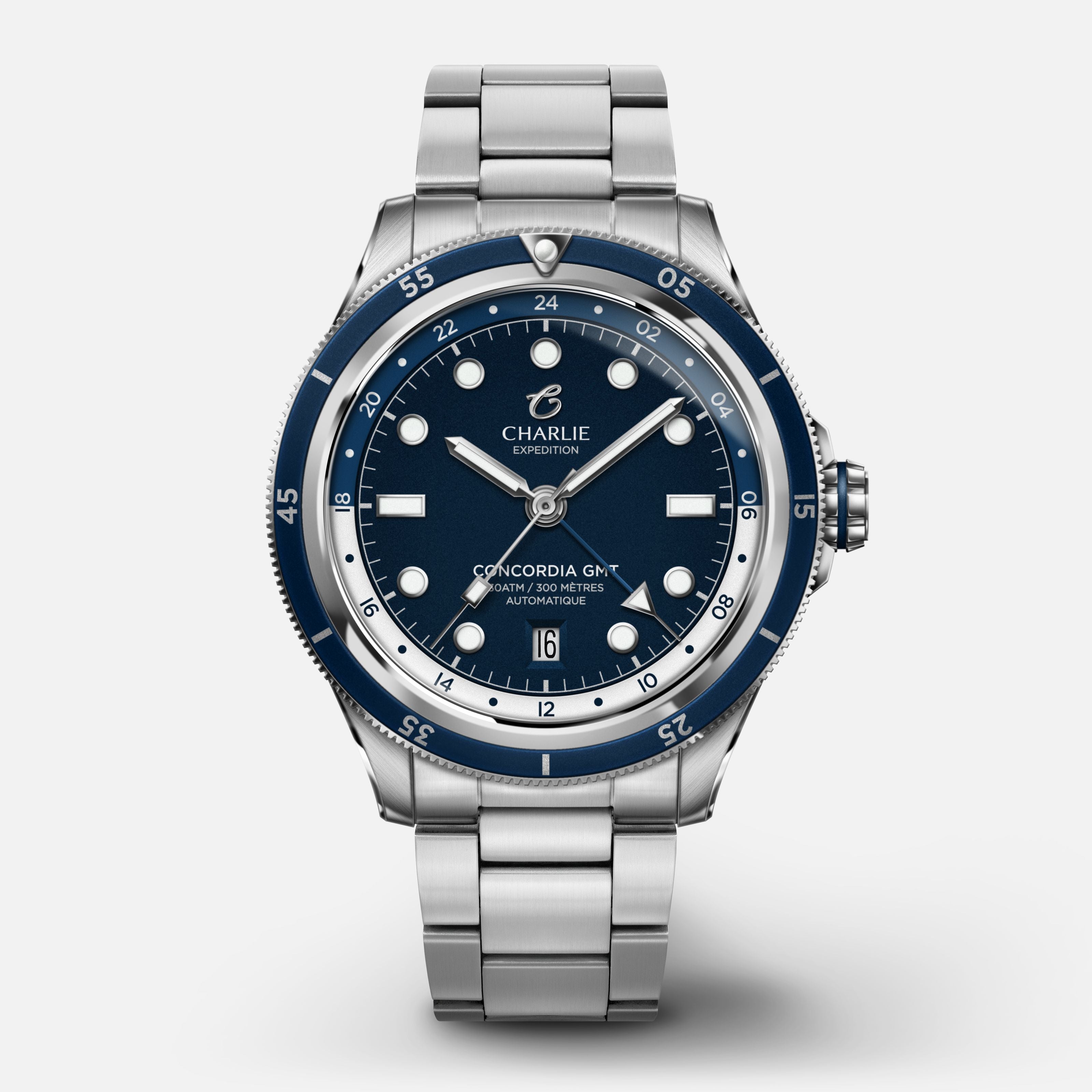
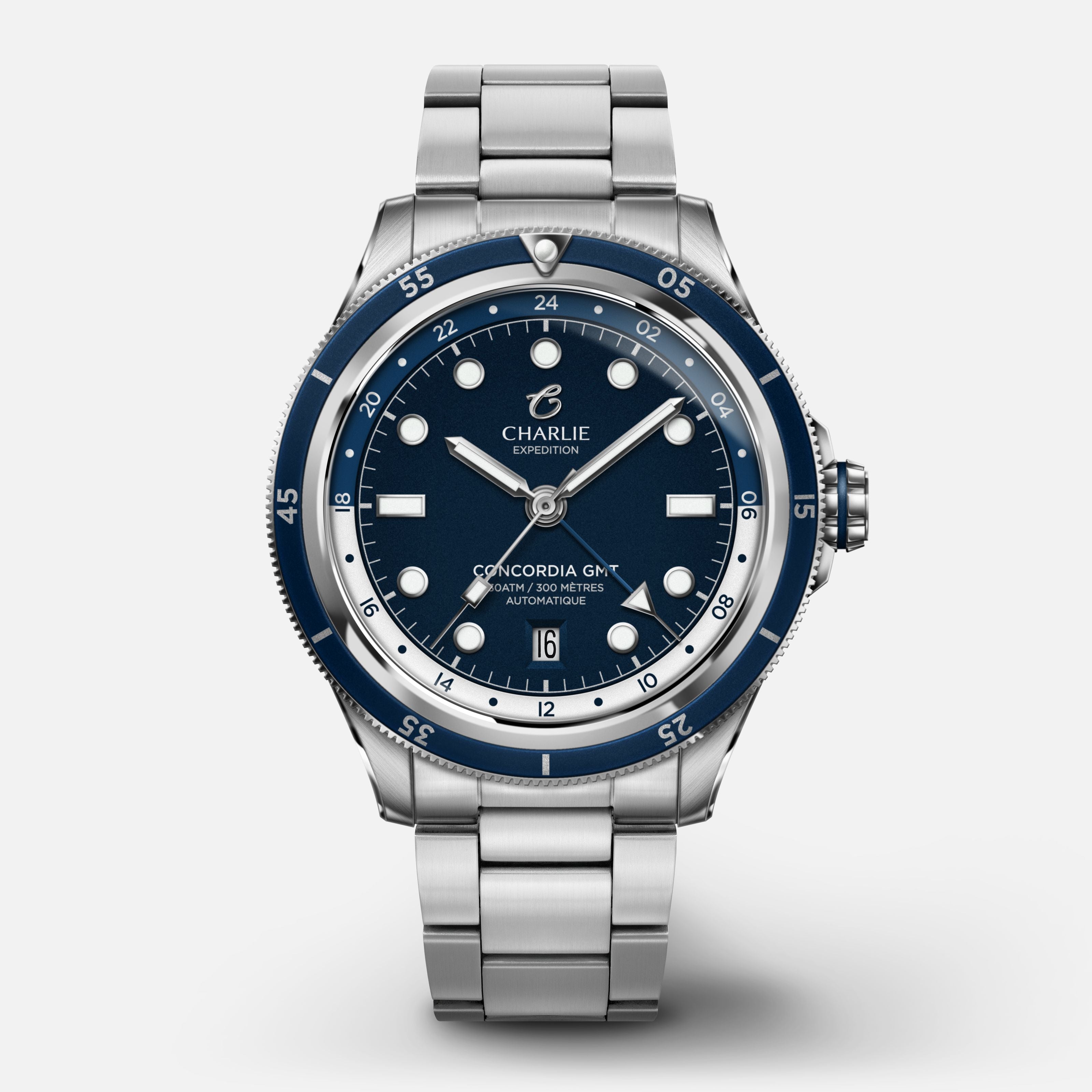
Concordia GMT Charlie Paris offers four distinct models: Kraken, Nazaré, Antarctic Blue And Dune. Four interpretations of the same philosophy: to offer a robust, elegant GMT watch designed for adventure.Whether you're a diver, traveler, or urban explorer, the
Concordia GMT ticks all the boxes of a GMT watch… and a diver's watch. Water-resistant to 300 meters thanks to its screw-down crown, which features a red insert indicating when it's open, it's also equipped with a unidirectional rotating bezel with a luminescent marker at 12 o'clock. ItsCase Measuring 40 mm, lightweight and ergonomic, it fits perfectly on the wrist for optimal everyday comfort. Its two-tone flange allows for intuitive reading of the second time zone, while its fourth hand stands out from the others with a unique color.Each variation has its own personality. The
Concordia The GMT Kraken, with its deep black sapphire crystal dial and hypnotic reflections, evokes the unfathomable depths. The Nazaré, inspired by the mythical Portuguese wave, plays on shades of blue and silver for a distinctly nautical spirit. The classic and timeless Antarctic Blue is a tribute to modern explorers, while the Dune, with its warm, sandy tones, recalls desert landscapes and...horizon distant places.As always with Charlie Paris, elegance meets practicality. Thanks to its quick-release pump system, the
Concordia GMT can be personalized in an instant with aStrap Steel, nylon, rubber or leather. A watch designed and assembled in Paris, which will accompany all your adventures, from the depths of the sea to the summits of the world.
Thus, the GMT has left its mark and continues to captivate watch enthusiasts. It first appeared to solve a very specific technical problem. Then it became popular on the wrists of travelers worldwide. Finally, it established itself as an essential complication in the world of watchmaking. That was the story of the GMT.


Read more
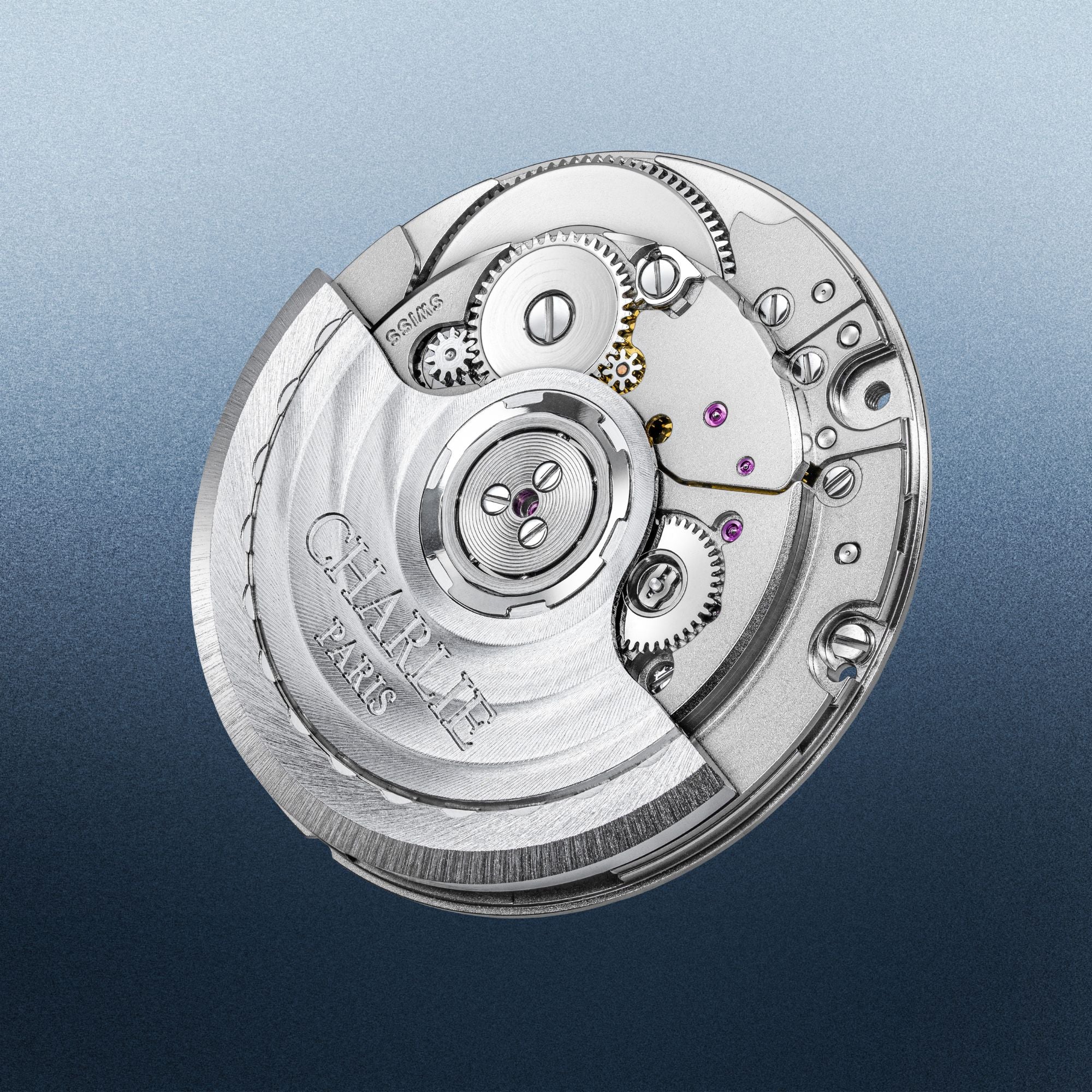
This movement will equip our models Concordia GMT offers a 42-hour power reserve and high reliability.
What is a watch complication? Calendar, tourbillon, power reserve, chronograph... Charlie Paris deciphers the complications of a watch for you.