









Watchmaking glossary - Watchmaking glossary
Here you will find a glossary of watchmaking terms. that you are likely to encounter during your research. For each of these terms, we offer a brief definition to help you understand them better. If you'd like to learn more about a word, please click on the link that will take you to a more comprehensive article. Happy reading!
316L Steel : 316L steel is a type of austenitic stainless steel with a carbon content not exceeding 0.02%, a chromium content of around 17%, and a nickel content of 10 to 12.5%. Molybdenum is added to this alloy, with a content of 2 to 2.5%. The "L" in the abbreviation 316L signifies that it is an austenitic stainless steel. Low carbon "(low carbon). Indeed, this steel contains only 0.02% carbon compared to 0.05% for 316 steel" classic 316L steel is very frequently used for the manufacture of
Needle : The hand is a thin, long piece of metal that, by moving across the watch face, conveys time information. Watches typically have three hands that indicate the hours, minutes, and seconds.
Alternation : In watchmaking, an alternation corresponds to the movement of the balance wheel from its equilibrium point towards one of its extremities. The " Tick Tock The term "alternation" in a watch refers to the movement of a pendulum or oscillating organ. Alternation is used to define a watch movement's ability to divide time intervals. The higher the number of alternations per hour (a/h), the more precise the watch. The balance wheel of a mechanical watch typically completes 5 alternations per second, or 18,000 per hour.
Applied : Appliqués are the indices or markings cut from a metal plate and then affixed directly to the dial.
Assembly : The process of assembling all the parts of a watch to obtain a complete and finished watch.
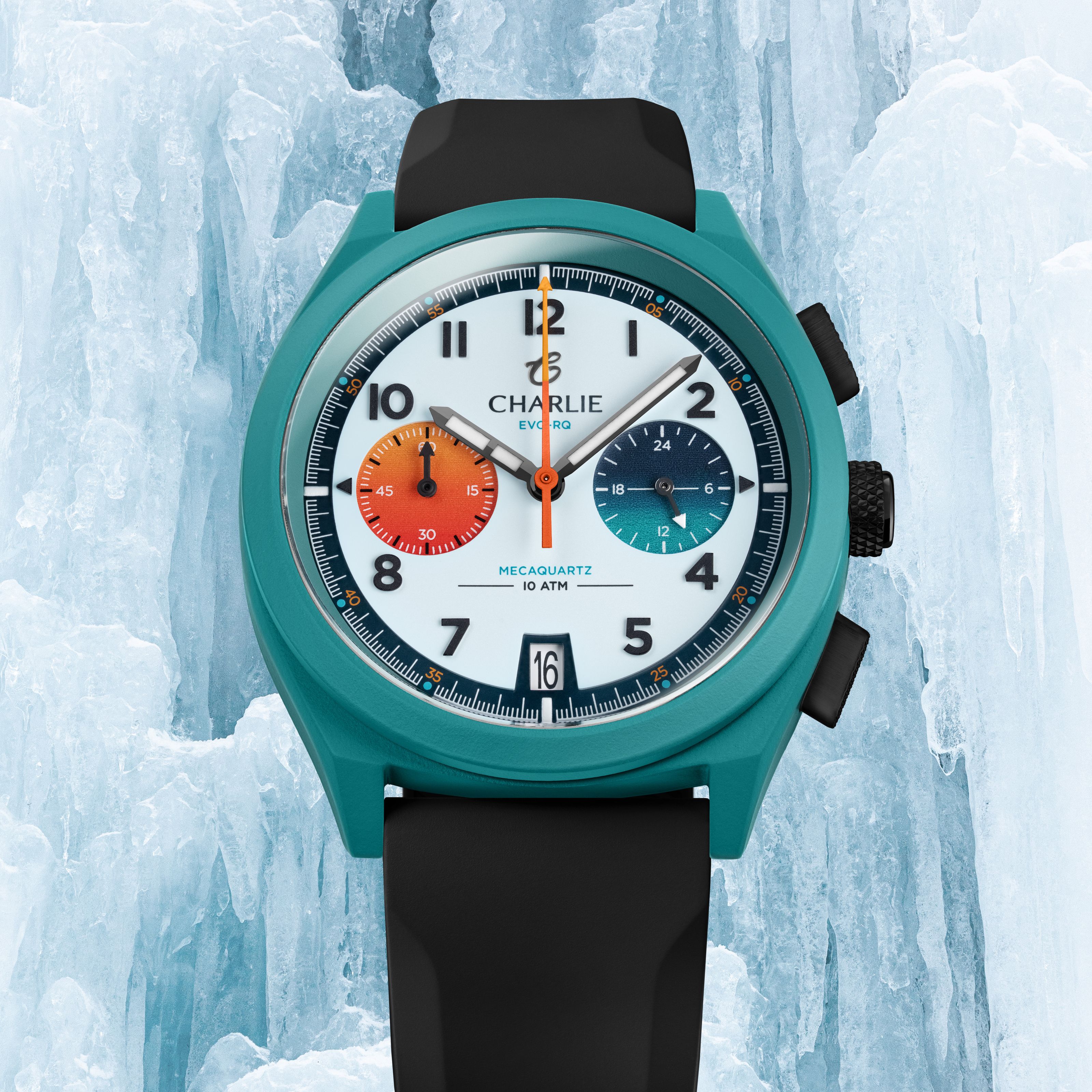
ATM : The atmosphere corresponds to the degree of water resistance of a watch. To give a water resistance value, the manufacturer uses the reference atmospheric pressure, which is 1, as a criterion. 013 hectopascals, or 1 bar. For example, a 10 atm watch means that it can withstand a pressure of 10 bars, or a depth of 100 meters.
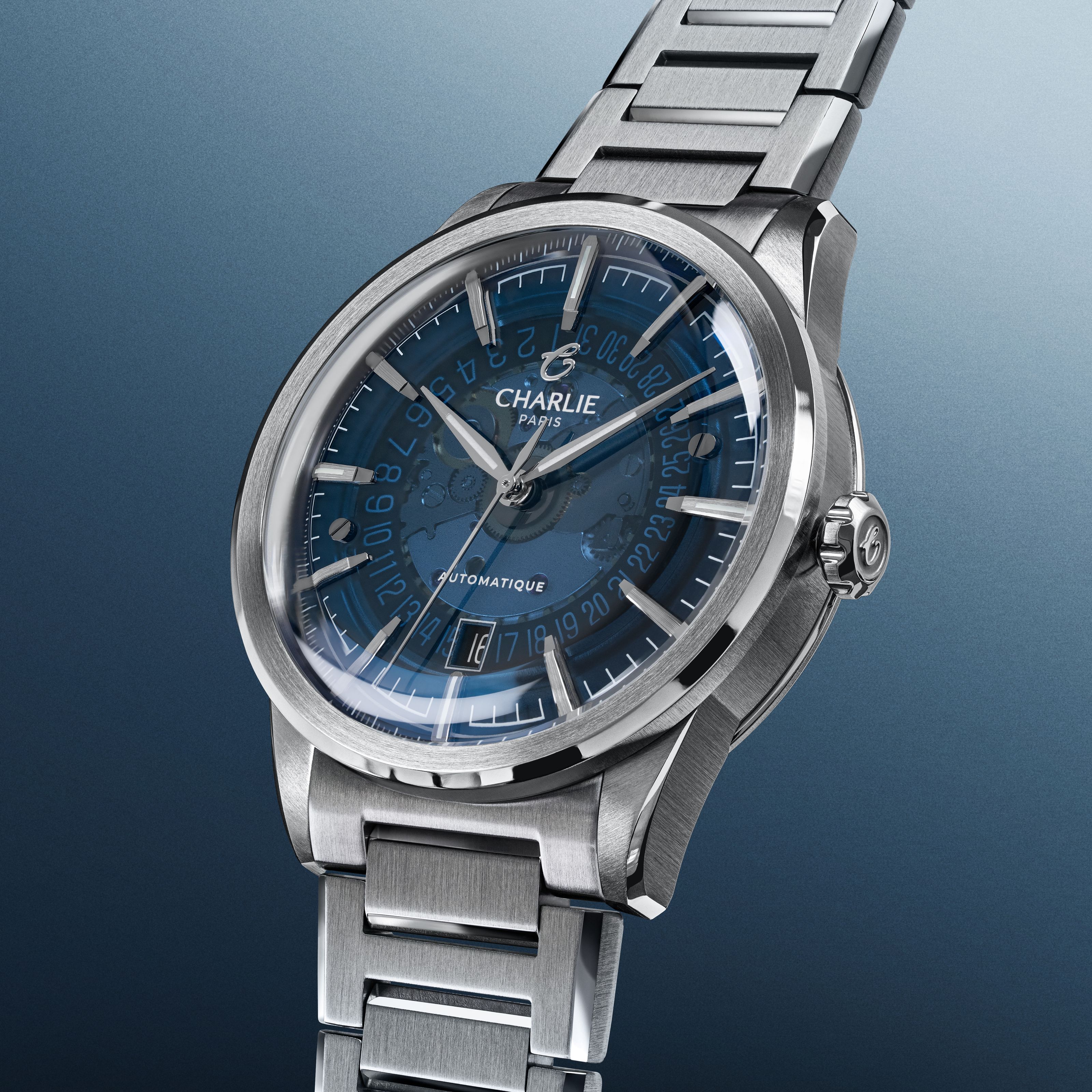
Automatic : A type of movement equipped with an oscillating weight that rotates thanks to wrist movements in order to wind the mainspring of a watch.
Balance : The balance wheel, a moving element usually circular in shape, is the organ that regulates the watch. It is what creates the vibrations within a watch. The balance wheel oscillates on its axis of rotation and is coupled to the balance spring, which allows it to impart a perfectly regular back-and-forth motion, called oscillation.
Barbed buckle : The tang buckle is the most classic type of clasp, consisting of a metal prong hinged on a loop that allows it to be closed thanks to a perforation in the
Deployment buckle : A folding clasp is a type of closure for the
Push buttons : These buttons placed on the
Dial : The dial is a usually metallic component that provides various information, such as hours, minutes, and seconds. There is a wide variety of dials available.
Framing : Refers to the parts that are placed under the dial of horological works.
Caliber : The caliber refers to the type of movement in a watch. This term was first used by
Groove : This grooved surface is found particularly on winding crowns for a firmer grip or on bezels for a stylistic effect. A watch with grooved surfaces is called a fluted watch.
Rail : A railway is a timer scale printed on the dial of a watch. As its name suggests, this timer scale resembles the tracks of a railway.
Chronograph : A chronograph is a watch that displays the hours, minutes, and seconds. It also features a hand that starts, stops, and resets with the simple press of a pusher. Minute and hour counters allow the chronograph hand to be tallied.
Stopwatch : The stopwatch function is applied to a very high-precision watch. Indeed, for a watch to be called a chronometer watch, the watch must be extremely precise and its High precision must be certified by tests carried out by an independent body. In Switzerland, the chronograph function is certified by an organization called COSC. (Official Swiss Chronometer Testing Institute). For a chronometer watch to be approved by the COSC, it must undergo seven tests at different ambient temperatures ranging from 8 to 38 degrees Celsius. The COSC conducts these tests to measure and verify the accuracy of its watch movement.
Cylinder : A cylinder is a round body of uniform size. The cord of a large clock is wound around a wooden cylinder called a roller.
Pawl : Part that holds the rocker and the wound spring in a clock or watch barrel.
Complication : Complications are mechanisms that a watch may possess, in addition to its basic movement, to provide information beyond just the hours and minutes. Such a watch is referred to as a complicated watch or a watch with complications. Examples include an alarm, a perpetual calendar, a tourbillon, time zones, or a chronograph.
Rooster : It is a support with various uses. The cock of a watch supports and covers the balance wheel.
Horn : The lugs are located at the top and bottom of the watch case and are used to attach the
COSC : The Official Swiss Chronometer Testing Institute (COSC) is a non-profit organization that awards the title of certified chronometer. To do this, a system of measurements and controls over a period of 15 days is rigorously implemented to guarantee the reliability and quality of the watches individually. For a mechanical watch, the acceptable rate deviation according to the temperatures and positions tested is between -4 and +6 seconds per day.
Crown : The winding crown is a button located on the outside of the
Crown targeted : As its name suggests, it is a crown that is screwed in to improve the watch's water resistance.
Limited editions : A limited edition refers to a watch manufactured in a specific quantity, often numbered, and available in limited quantities.
Engage : This is the effect of a wheel tooth entering the wing of a pinion.
Interlocking : In watchmaking, casing is a step in the assembly of a watch. This step consists of inserting and then securing the watch movement into the
ETA : One of the leading manufacturers of watch movements based in Switzerland.
Between the horns : The lug width is the distance between the two lugs of a watch. The lug width determines the size of the
Foliot : Former name for the pendulum.
Watch face : The back of a watch is part of the
Frequency : Measured in hertz, a watch's frequency refers to the number of oscillations the balance wheel makes in one second (usually between 5 and 10). There are two types of measurement for evaluating the frequency of an automatic movement. : Hertz and the number of alternations per hour (A/h). The higher the frequency of a watch, the more precise the oscillations of the balance wheel will be. It is these oscillations of the balance wheel that produce the ticking sound of watches.
GMT : Abbreviation meaning " Greenwich Mean Time This term refers to solar time at the Greenwich Observatory meridian in England, which is a civil time of 24 hours beginning at midnight. On a watch, the GMT function refers to displaying a second time zone simultaneously with the local time.
Ticket office : The date window is an opening in the dial that allows information to be displayed. Most often, this is the date and day.
Guilloché : Guilloché is a decorative technique in watchmaking. This decoration can be applied to the dial and the
Hertz : In watchmaking, the Hertz (Hz) is used to measure the rate of a movement. It is a unit of measurement for the frequency of an event per second.
Index : The term "index" refers to the hour markings on a watch dial. Traditionally, watches had a dial that displayed the hours using Roman or Arabic numerals from 1 to 12. Over time, a new way of marking time on the dial emerged. Indexes are markers, usually small, thin lines, that replace the numerals.
Luminescence : There Luminescence refers to the emission of light rays. In watchmaking, it is the covering material the index and hands allowing To tell the time in the dark, the LumiNova system is used.
LumiNova : This is a luminous paste composed of tritum bulbs that stores light and then reflects it once immersed in darkness. This material made it possible to eliminate the radium salts present in the tritium and thus eliminate the radioactive property of this material.
Telescope : The scope is one of the main elements of
Rotating telescope : Rotating, graduated bezel positioned on the upper part of the
Magnetization : Magnetization refers to the adverse influence of magnetic fields on the operation of a watch. Magnetic fields are emitted by smartphones, tablets, induction cooktops, speakers, televisions, etc., and watches are sensitive to their radiation. A magnetized watch may suddenly run slow or fast and can stop without any apparent shock or accident.
Manual : Refers to a mechanical watch that is wound by hand, i.e., manually wound.
Manufacture : The manufacture is a symbol of quality in watchmaking. A manufacture refers to a factory that produces its products almost entirely by hand. This term particularly evokes a movement developed entirely by a brand.
Oscillating mass : The oscillating mass, also called the rotor allows an automatic watch to continue running as long as its owner wears it on their wrist. The oscillating weight is the part that allows the watch to wind and wind its power reserve. barrel spring thanks to wrist movements. When the watch face This part is transparent and visible on the back of the watch. It is often decorated with engravings, and on generic movements, it usually features the watch brand's logo.
Analog watch : A watch whose dial, hands, numerals or indices display the total time over a 12-hour period. The 12-hour analog display shows the time and, if integrated, the day and date.
Mechanical watch : A mechanical watch, as opposed to a quartz watch, is a watch that operates without a battery. It is powered by a manual winding movement, requiring daily winding by turning the crown, or an automatic movement that winds itself through the wearer's movements via a rotor spinning around an axis.
Movement : A watch movement is the set of parts that make a watch function. There are different types of watch movements. : Quartz movement, manual-winding mechanical movement, automatic-winding mechanical movement. On average, a simple mechanical movement comprises 130 parts. Overall, the movement includes the blank, the regulating organs, and numerous other components. : springs, pivots, screws, shock-absorbing system, gears, stones, etc.
Regulatory body : The regulating organs, also called regulators, are parts of A watch or clock's regulators are used to divide time into seconds, minutes, and hours, sometimes even hundredths or thousandths of a second. Regulators also serve to indicate the date or any other type of information found on watch complications. In a mechanical watch, the regulating organs are the balance wheel and the balance spring, which are linked to... the watch escapement anchor.These different parts will receive the energy from the gears, then they will perform the counting and division of time.
Oscillation : Oscillation represents the back-and-forth movement of a pendulum or balance wheel between two extreme positions. An oscillation consists of two alternations; it's the familiar ticking of a watch.
Little Second : The small seconds hand displays the seconds in a separate subdial, unlike the large seconds hand, whose axis is located in the center of the watch. The small seconds hand is usually found at 6 or 9 o'clock.
Platinum : This is one of the plates in the case of a watch or clock. This plate supports several watch components.
Bridge : Refers to all the parts that are fixed and used to support parts which are located on the turntable.
Push button : It is the counterpart or button of a repeater watch.
Date : In watchmaking, the date refers to the day number of the current month. This date indication is presented either as a rotating disc or by a hand.
Annual calendar : The annual calendar is a horological complication that allows you to keep track of the time. taking into account that the 12 months of the year do not all have the same number of days. An annual calendar is therefore capable of correctly displaying the date of the first of the months following a 30-day month: the date will, for example, jump directly from April 30th to May 1st without displaying April 31st. However, the transition from February 28th to March 1st requires manual intervention in non-leap years.
Perpetual calendar : The perpetual calendar is a horological complication that allows the time to be taken into account. The fact that the 12 months of the year do not all have the same number of days, as an annual calendar might. But the perpetual calendar also takes leap years into account.
Date centuries : The perpetual calendar allows for leap years, but this will not be the case on March 1, 2100, a centennial year, and therefore not a leap year. This is precisely the distinguishing feature of the centennial calendar: it takes into account the fact that a centennial year is not a leap year.
Quartz : A quartz movement is an electronic movement whose timekeeping is ensured by an oscillating quartz crystal. A battery provides the watch mechanism with the energy it needs to operate. Quartz watches contain a small slice of quartz crystal, a mineral composed of silica atoms whose defining characteristic is piezoelectricity. Quartz has the property of emitting vibrations at regular intervals when subjected to an electrical current. Unlike a mechanical movement, a quartz movement is virtually inaccurate.
Automatic winding : Automatic winding is more technically advanced than manual winding. Wrist movements initiate the action of the rotor, which then rotates on its axis. This movement winds the mainspring through a system of gears. The first time you wear an automatic watch, you need to wind it manually to activate the automatic winding mechanism for subsequent use.
Manual reassembly : Manual winding involves manually turning the winding crown of a watch. It is also possible to wind an automatic movement manually. As soon as you feel a slight resistance, The watch is fully wound. And you must stop.
Power reserve : The power reserve refers to the amount of time a mechanical watch can run without the user needing to wind it. The watch operates thanks to the tension of a mainspring. When this mainspring is no longer sufficiently wound, the watch must be wound, meaning the necessary tension must be restored to the mainspring so that it can start running again.
Barrel spring : The mainspring is a component that regulates the watch. It is a moving part, generally circular in shape, that oscillates on its axis of rotation. The balance wheel contains a spring called the balance spring, which allows it to oscillate back and forth in a perfectly regular manner. This movement divides time into equal intervals.
Ressort spiral : It is a very small, spirally turned blade that is applied to the pendulum of a watch to regulate the vibrations.
Ronda : The second largest Swiss manufacturer of movements (after ETA).
Rotor : The rotor, also called "oscillating mass" allows to an automatic watch to continue running as long as its owner wears it on their wrist. The oscillating weight is the part that allows the barrel spring thanks to wrist movements. When the watch face This part is transparent and visible on the back of the watch. It is often decorated with engravings, and on generic movements, it usually features the watch brand's logo.
Exhaust wheel : The exhaust wheel is one of the main components of an automatic watch. Its function is to release the energy carried by the gears to the anchor, intermittently and regularly. It is the watch's maintenance component.
Ruby : The ruby is a precious stone belonging to the corundum mineral family and is red in color. Widely used in the jewelry industry, it has also lent its name to a component used in watchmaking. Rubies serve to reduce friction caused by the watch mechanism at certain points in the movement. By minimizing wear and tear from this friction, rubies extend the watch's lifespan.
Sellita : Sellita is an independent Swiss company specializing in the assembly of "Swiss Made" automatic mechanical movements.
Second : The second is the basic unit of time. Until 1967, it was defined as a fraction of a mean solar day. As clocks became increasingly precise, the definition of the second was changed at the Weights and Measures Conference in October 1967 to become the atomic second.
Spiral : The balance spring is a small, spiral-shaped spring that regulates the movement of a watch. It returns the balance wheel to its original position.
Tachometer : A tachymeter is a tool used to measure the speed of a moving object or person. On a watch, the tachymeter is a graduated scale, usually located around the edge of the dial, that allows you to estimate average speed by measuring the time it takes to travel a certain distance. Speed is usually measured in kilometers per hour works the most often with the seconds hand. This concept is also found in the world of watchmaking. on the chronograph watches.
Winding stem : The winding stem is a small rod that protrudes from the watch and can be rotated. At the end of the winding stem is a knob, called the winding crown. It is used to connect the external components of the movement for winding and setting the time or date.
Whirlpool : The tourbillon is a horological complication whose primary purpose is to reduce the effect of gravity on the functioning of a Mechanical watch. By reducing the effect of gravity on the movement of a mechanical watch, it becomes more precise. This mechanical device was developed by Abraham-Louis Breguet in 1801. The tourbillon contains the components that allow the balance wheel to oscillate within a small, rotating cage at the center of the watch, completing one revolution per minute.
Trotter : The sweep second hand is the name given to the seconds hand, which moves in short, jerky motions, following the oscillations of the balance wheel. The large sweep second hand is fixed in the center of the dial, while the small sweep second hand is placed on a separate subdial.
UTC : The acronym UTC stands for "Coordinated Universal Time". As its full name indicates, it is a time scale, adopted in 1972 to uniformly define international civil time.
Sapphire glass : Sapphire crystal is a material traditionally used in watchmaking and is highly valued by watchmakers because it is virtually scratch-proof. Sapphire crystal is a very high-quality, highly resistant glass.
Mineral Glass : Type of watch glass. It's an affordable glass, relatively impact-resistant and impervious to UV rays. U.V. Mineral glass, however, is less resistant than sapphire glass.